


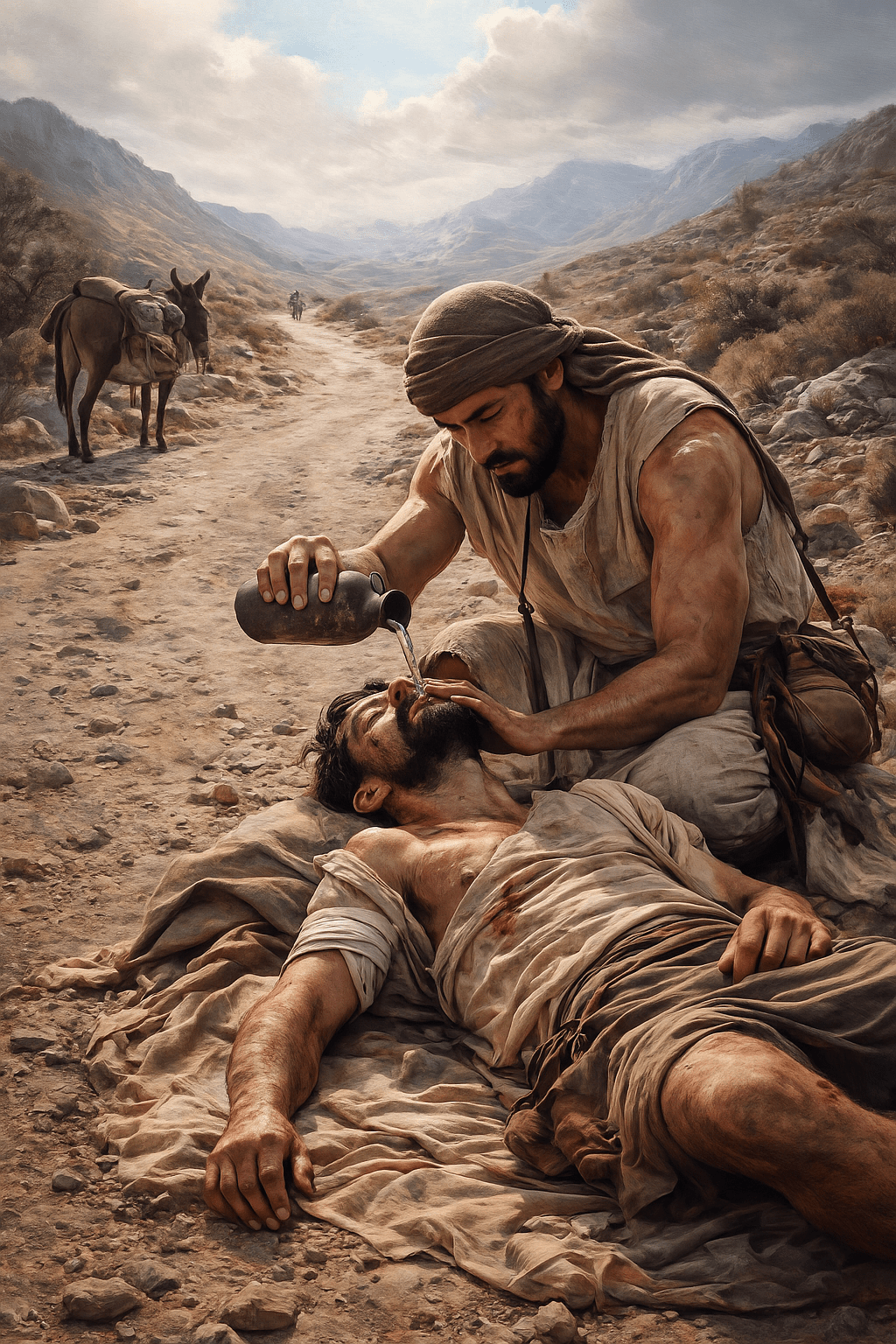
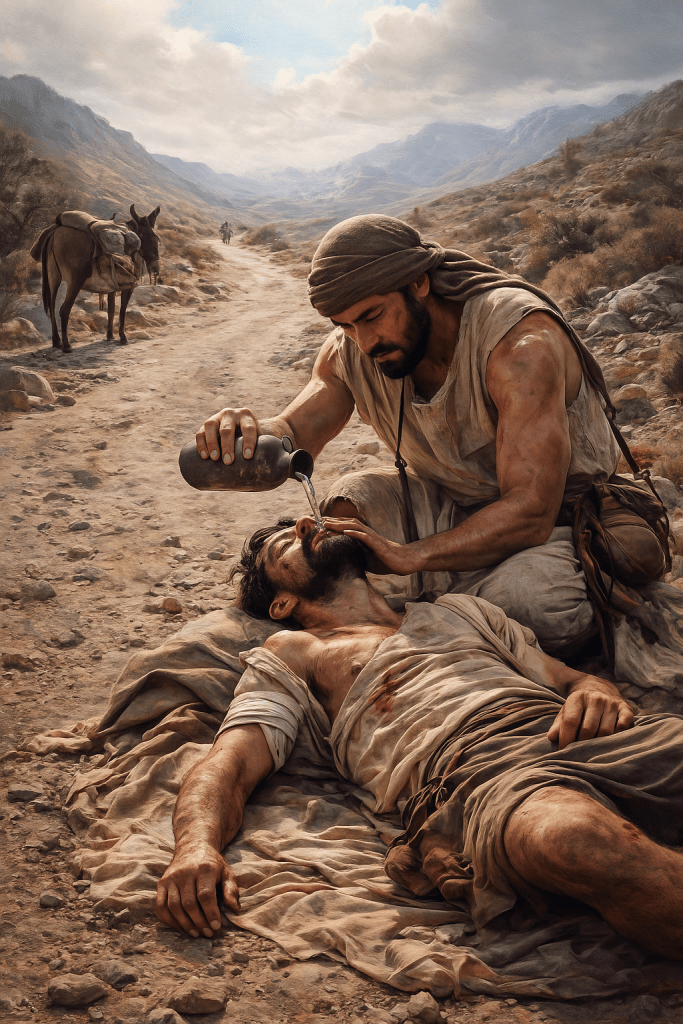
(Luke 10:25–37)
Who is my Neighbor?
I’m not the first to ask that question,
but Jesus’ reply flipped that notion.
Instead of the answer the “expert of the law”
may have wanted to hear,
perhaps that your Neighbor is the people you already like,
Jesus gave the illustration of the “Good Samaritan,”
a people generally hated by the masses of his listeners.
Instead of showing the same prejudice in return,
when this human, scorned by society,
came upon a broken, neglected man,
his heart felt pity for this unfortunate one who,
if conscious, would likely on any other day
disdain the traveling Samaritan,
a person of another race, faith, and culture.
He would, like the listeners of this parable,
judge this man by his labels
and not allow himself to see their commonalities,
he too being a man that shared the same space in life
with all of its challenges and trials.
But today this man lied on the road,
lifeless and broken,
left for dead by those who would abuse him
in order to take for themselves
all that he had for their own selfish gain.
A man now laying listless
while others step over his tattered existence
or, with even more disdain
for this member of their own family and beliefs,
chose instead to further themselves from him
by crossing the road as far as possible
without overly inconveniencing themselves
by their shattered brother’s demise.
But not the Good Samaritan.
This fellow pariah of society
could not look upon the misfortune before him
and not bring himself to adopt responsibility
for the one he would soon call brother.
Perhaps he saw in the physical wreckage before him
a reflection of the abuse and pain
that existed inside of himself.
His empathetic heart could feel the turmoil
and damage that likely the lifeless body
that laid before him
had numbed out in the shock of this tragic encounter,
to protect itself from unimaginable anguish.
How could he live with himself
if he ignored the plight of his fellow creature
so loved by their Creator?
So he took from his resources,
perhaps themselves limited
because of the misfortune of his birth.
He patched up his fellow work of God’s hands.
He lifted him up
and transported him to a place of safety and recovery.
He stayed with him and watched over him,
and once convinced
that the man had taken a turn for the better,
continued with the necessities of his own life
with full intentions and promises
to return quickly
to check on his newly minted neighbor
in order to continue to provide for his healing
with freshly procured funds.
What was the lesson of Jesus’ story?
It was clear with one question:
“Who made himself a neighbor to this victimized man?”
The half-hearted reply of the so-called expert:
“The man who showed him mercy.”
But did he get the point?
This overconfident Lawyer
had asked the wrong question.
Jesus’ response was meant to correct his perspective.
He should have asked,
How can I better reflect the love
that God has for my fellow man?
I also have choked on this question.
You see, love for God,
who has only shown love for me in overabundance,
came easy.
But people?
They were strange and critical
and seemingly indifferent
to the plight of others.
So why should I love those
who have no love for me
or each other
or even themselves?
But here I am
lying, bleeding, fractured, numb, and helpless,
walked over and neglected.
But you, my fellow miscreants of society,
embraced me.
You opened yourselves to me,
patching my wounds
while healing your own.
You showed me love and empathy,
along with security and true camaraderie.
You made yourselves my Good Samaritans.
You have shown me the proper perspective
with your goodness,
which has always existed inside you,
though perhaps at times forced to lay dormant.
You have healed me
instead of leaving me for dead.
You have loved me
more than you’ve been allowed to love yourselves.
In this reflection of your love,
you have taught me
that which has always eluded me…
In order to truly love my Neighbor,
first I must learn to love myself.
— Jesse Lee 11/14/2025
 Friends of Sobriety
Leave a comment